From Stiff Fingers to A Piano Performer: The Real Journey of Piano Practice
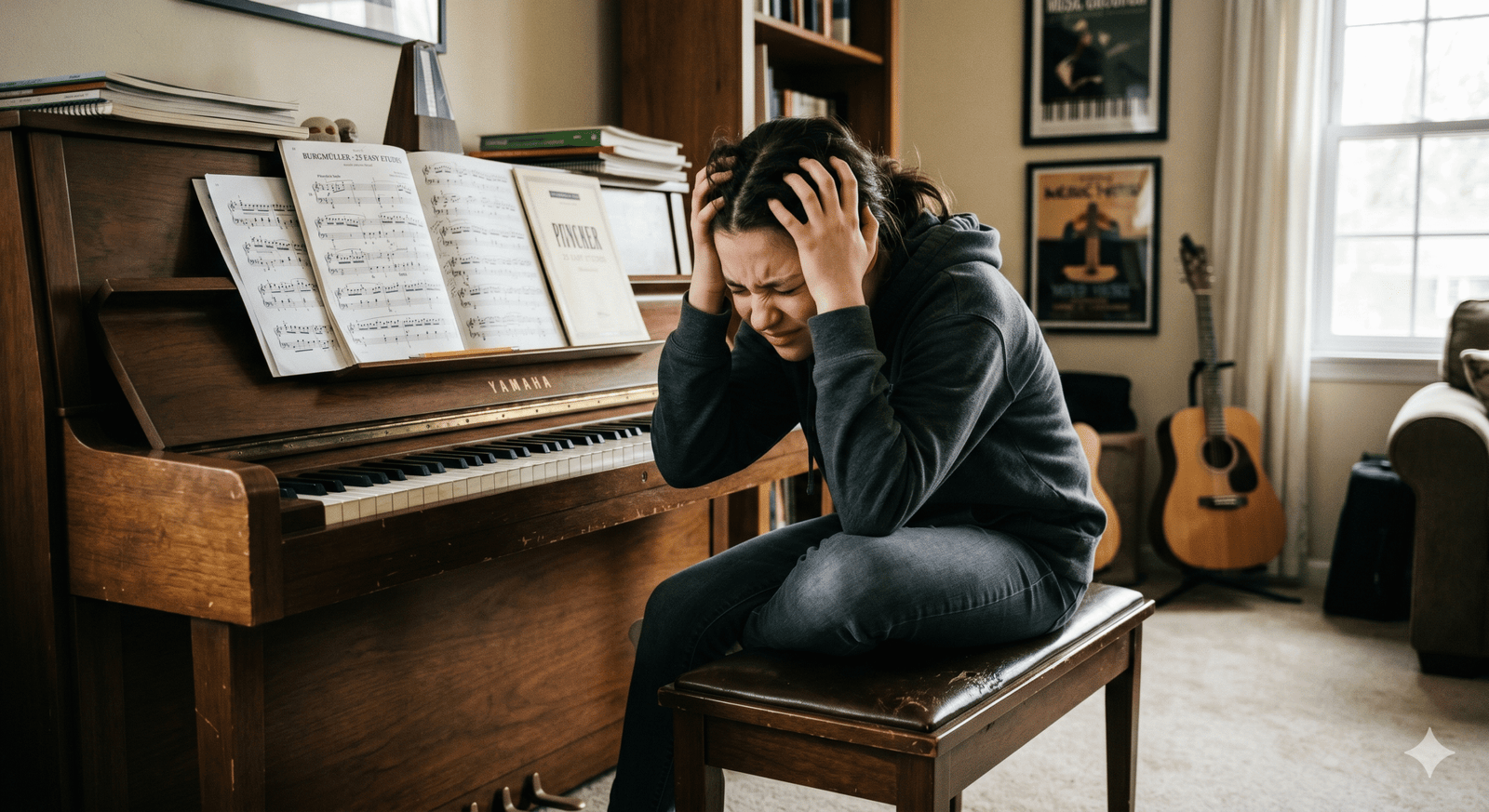
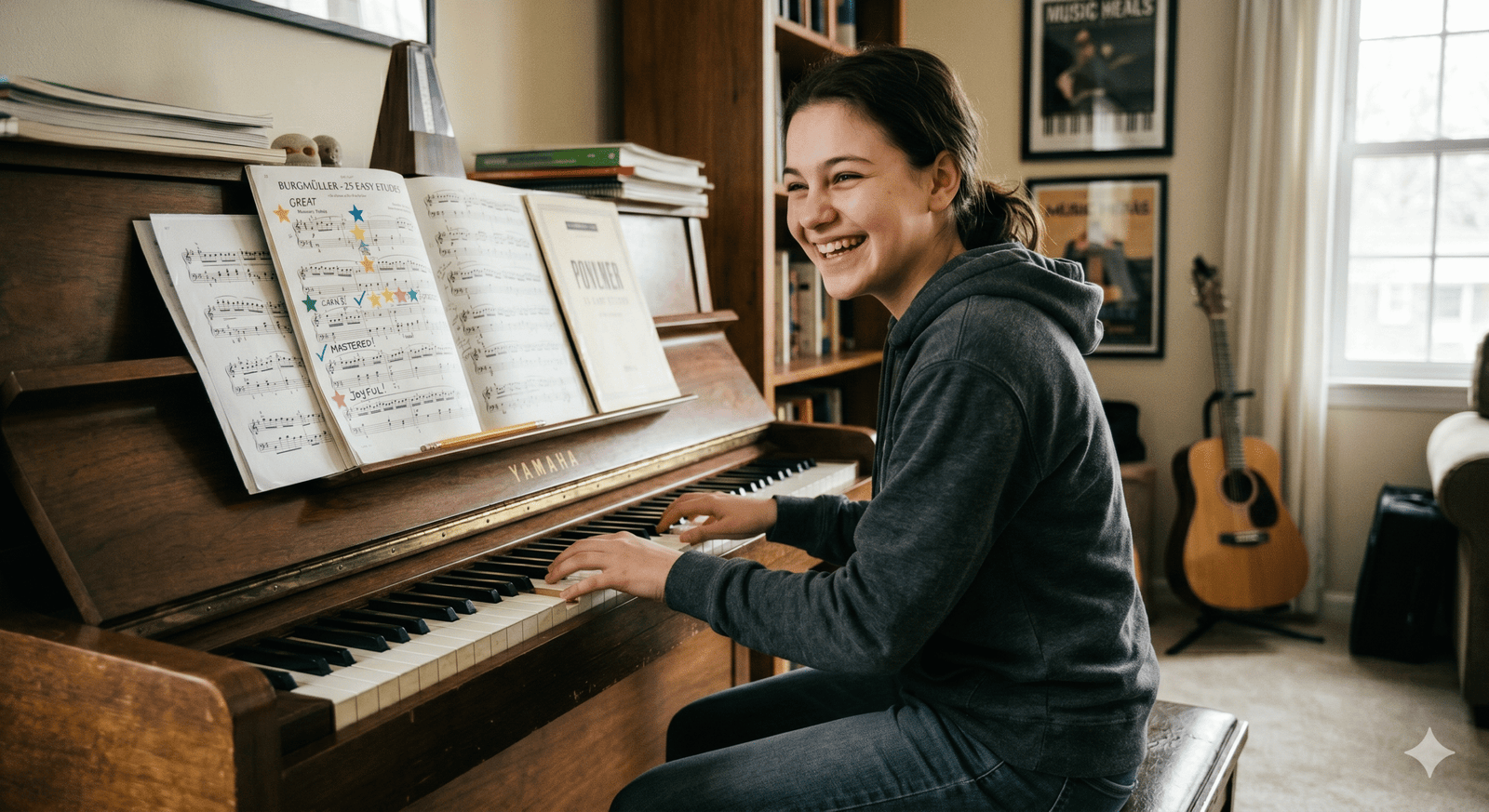
Every pianist knows the frustration of the first week with a new piece. Your fingers feel like lead, your wrists are stiff, and just reading the notes takes every ounce of your concentration. Then, weeks or months later, a breakthrough happens: you sit down, look out the window, and your hands fly across the keys entirely on their own.
What feels like magic is actually a beautiful transformation happening inside your body. Your fingers haven’t gotten smarter—instead, your brain and your muscles have built a dedicated, lightning-fast connection.
To take a piece from the first sight-reading session to a flawless performance, you have to guide your body through three natural levels of practice. Here is what is actually happening at every stage of the journey.
Level 1: The “Sight-Reading” Stage — Mapping the Notes
- The Experience: Deciphering the score, figuring out fingerings, and finding the keys.
- Brain Power Required: 100% Maximum Focus.
At this stage, your brain is doing heavy lifting. It has to look at the sheet music, translate a note on the staff into a pitch, choose the right finger, and tell your hand where to go.
Because this musical pathway is brand new, your body doesn’t know how to economize its energy yet.
- The “Tension” Trap: When your brain sends the signal to drop your 3rd finger, it accidentally sends extra nervous energy to your shoulders, wrists, and neighboring fingers. This is why beginners and students feel so physically stiff—your muscles are fighting each other because they haven’t learned the “blueprint” of the piece yet.
The Goal of Level 1: Perfect Accuracy over Speed. Think of this as drawing a map. If you practice mistakes or sloppy fingerings now, you are accidentally mapping out a detour. Slow down so your brain can send a clean, clear instruction to your hand.
Level 2: The “Polishing” Stage — Finding the Flow and Ease
- The Experience: Putting hands together, smoothing out technical hurdles, and refining the rhythm.
- Brain Power Required: Medium. You no longer need to stare at every single note, but you must focus deeply on how your hands feel and move.
As you repeat a passage correctly dozens of times, your body undergoes a massive shift: it begins to eliminate unnecessary tension.
- The Release of Tension: In the first week, your muscles are tight. In this second stage, your hand learns the art of instant relaxation. The exact millisecond a finger finishes striking a key, the muscle relaxes while the next finger takes over.
- Balancing the Touch: Your brain stops treating every note like an emergency. It learns the exact amount of arm weight needed for a delicate pianissimo run versus a heavy forte chord. Your movements change from jagged and robotic to smooth and choreographic.
The Goal of Level 2: Fluidity and Effortless Technique. You are teaching your body to achieve the maximum musical beauty with the absolute minimum physical effort.
Level 3: The “Artistry” Stage — True Muscle Memory
- The Experience: Performance-ready. The notes take care of themselves, leaving you free to focus entirely on expression, phrasing, and the “soul” of the music.
- Brain Power Required: Subconscious. Your conscious mind steps back and lets your hands take the lead.
This is the ultimate destination: Muscle Memory. In the scientific world, this is called automation. The control of the piece has officially moved out of your conscious, thinking brain and into your deep, subconscious movement centers.
Two amazing things happen to lock this stage in:
- The Musical Superhighway: Every time you repeat a movement patterns correctly, your body wraps that specific nerve path in a layer of natural insulation. Uninsulated pathways are slow and clumsy. Well-insulated pathways send signals instantly, allowing your fingers to execute rapid ornaments, scales, and leaps without you having to consciously think about them.
- Built-in Quality Control: Your body has internal sensors that feel the keys. At this level, if a leap is a millimeter off or a chord is slightly unbalanced, your subconscious corrects the weight of your hand in real-time—before your conscious mind even realizes a mistake almost happened.
The Takeaway for Your Practice Room
| The First Week | The Mastered Performance |
| Exhausting: Massive mental energy just to find the notes. | Effortless: The mind is free to interpret the emotion of the music. |
| Stiff: Muscles fight each other, causing tension. | Relaxed: Only the active fingers work; the rest of the hand rests. |
| Slow: The brain-to-finger connection is a bumpy dirt road. | Instant: The connection is a lightning-fast highway. |
Understanding this journey changes how we approach the piano. The time it takes for the body to build these internal highways cannot be rushed. The next time a stubborn passage feels frustrating, remind yourself: it isn’t just practicing a piece of music—it is building a bridge between the mind and the keys. Keep it slow, keep it accurate, and let the body do the rest.
A Note for Parents: Navigating the Journey at Home
2pianoteacher, June 2026
Living on both sides of this fence—as both an educator and a parent—reveals a profound truth. In the studio, it is easy to celebrate the brilliant spark when a student catches a rhythm. At home, however, we have to live with the beautiful, messy friction of our own children grinding through a new piece.
When a child is at Level 1, their home practice is going to sound slow, fragmented, and—honestly—a little tedious. You might hear them hesitate, repeat the same three notes, or stop entirely.
As a parent, the natural instinct is often to nudge them: “Can you play it faster?” or “Make it sound like a song!”
But from a pedagogical standpoint, the best support is to let them slow down.
Right now, their brain is doing the heavy lifting of sketching that internal map. Rushing into making it “sound like a song” too early forces them to map out mistakes. When you hear that slow, cautious practice, it isn’t a sign that they aren’t getting it. It is the sound of deep learning. Celebrate it—they are actively building the foundation for total mastery.